
Union County Arrest Records and Court Charges
Union County arrest records are law-enforcement and jail-side records. They may show the arrest agency, booking date, inmate number, listed charges, bond notation, warrants, detainers, or probation violation labels. The Union County Sheriff's Office jail roster is a public PDF list, not an interactive booking database. It gives a current custody snapshot and should not be read as the final court outcome.
Court charges after arrest begin when the prosecutor files formal charges in court. The Union County District Attorney's Office prosecutes crimes committed in the county and decides what charges to file, amend, reduce, dismiss, or pursue. Once filed, the charge appears in the criminal court case and is tracked through arraignment, plea, motions, hearings, disposition, and sentence. The full case file belongs with criminal court records, while the booking and custody side belongs with inmate records.
The corrections source from Union County Sheriff's Office shows the jail context behind arrest and booking records.
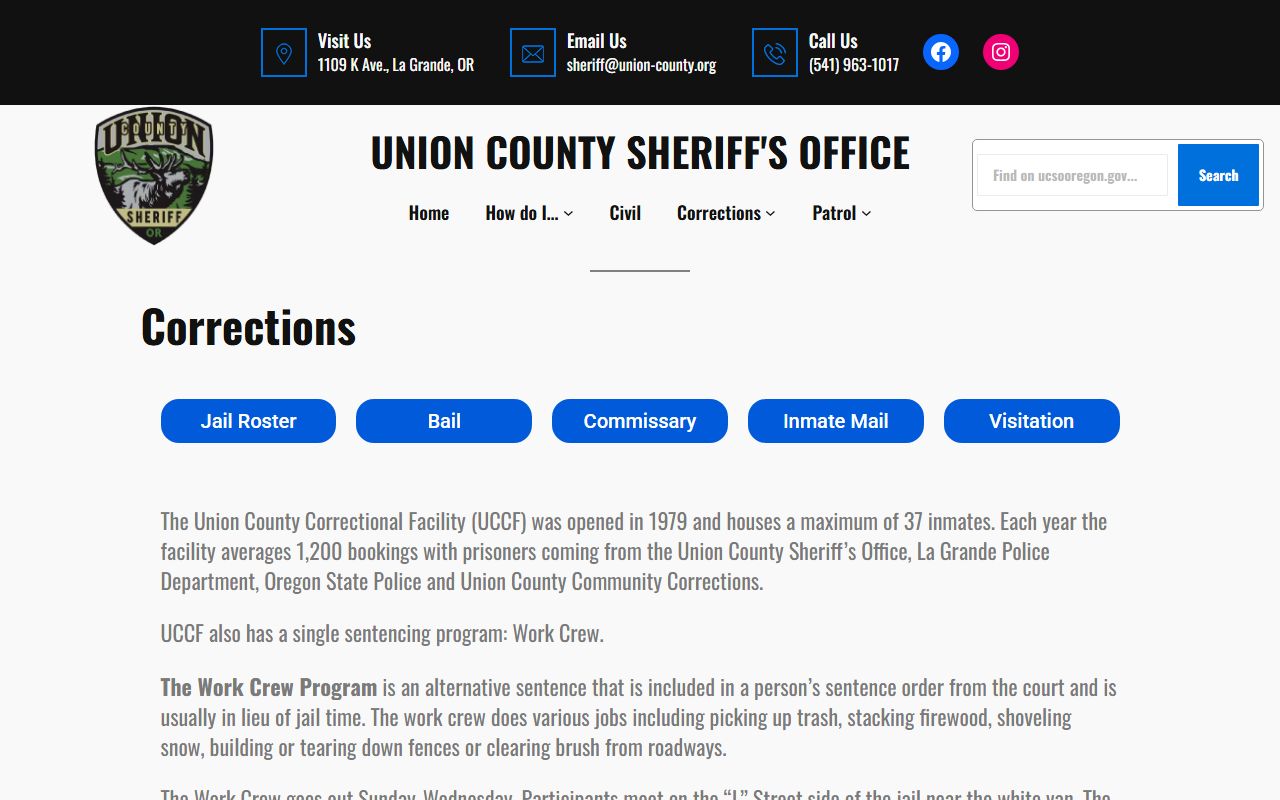
That jail source supports the local arrest-record side before charges move through court.
Find Union County Arrest Records
Use two channels because arrest records and court charge records do not come from the same office. Current custody and booking charge lines come from UCSO's jail roster and jail information channels. Filed court charges, charge status, pleas, and dispositions come from OJD records and calendars, OECI, or Union County Circuit Court records requests. A person who needs all court records for a case should use the broader Union County court records process.
- Check the UCSO jail roster or jail phone line when the question is current custody or booking information.
- Use OJD records and calendars or OECI when the question is the filed court charge.
- Search by defendant name or case number, then read each count and current disposition separately.
- Request sheriff case reports, jail records, or photographs through UCSO when the needed record is law-enforcement held.
- Use Oregon DOC or the Oregon State Police registry only when the person is outside the county jail context.
Statewide lookups have limits. The Oregon DOC Offender Search is for sentenced state-prison or post-county custody contexts, not every local arrest. The Oregon State Police Sex Offender Registry is a public registry for publishable offender information, not a complete criminal history or arrest search.
Charging Documents After Arrest
An arrest can happen before the final charging decision. Jail roster charge labels may reflect arresting-agency information, warrants, detainers, or probation violations. The court charge record begins when a charging document is filed. Oregon criminal court records can use charge names and ORS references, and one arrest can lead to several separate counts with different outcomes.
| Complaint | Information | Indictment | |
|---|---|---|---|
| Filed by | Often prosecutor-filed, sometimes tied to officer complaint procedures. | Prosecutor. | Grand jury through prosecution process. |
| Common use | Initial criminal accusation or lower-level matter depending on procedure. | Formal prosecutor charging instrument. | Grand-jury charge, often for more serious felony matters. |
| Record effect | Starts or supports the court case and charge list. | Sets the prosecutor's filed charges. | Sets charges returned through grand-jury process. |
| Reader caution | May later be amended or dismissed. | May replace or amend earlier charges. | Still must be resolved by plea, trial, dismissal, or other disposition. |
Charge Status and What It Means
Charge status changes as the case moves. The first public charge label may not match the final court result. A count can be pending, amended, reduced, dismissed, merged, or resolved by conviction. A warrant, detainer, or probation violation listed in a roster may also turn into a court event, but it is not the same thing as a new conviction.
| Status | What It Means |
|---|---|
| Pending | The charge is filed or listed, but the court has not entered a final disposition for that count. |
| Amended | The prosecutor or court record changed the charge label, statute, count, or detail. |
| Reduced | The filed accusation was lowered to a lesser offense or different count. |
| Dismissed | The charge was not pursued to conviction or judgment on that count. |
| Convicted | The court entered guilt or judgment after plea or verdict. |
| Set aside | An eligible arrest, charge, or conviction was later sealed by court order under Oregon law. |
Charges vs. Convictions
Charges and convictions must be kept separate when reading Union County arrest records and court charges. A roster can show a charge or warrant-related label at booking. The court file can later show that a charge was dismissed, amended, reduced, or resolved by conviction. The final judgment or disposition controls the outcome.
| Charge | Conviction | |
|---|---|---|
| Stage | Arrest, booking, or court filing accusation. | Court outcome after plea, verdict, or judgment. |
| Where found | Roster, charging document, docket, or case register. | Disposition entry, judgment, or sentence. |
| Meaning | The person is accused of a specific offense. | The court has entered guilt or judgment. |
| Public caution | May be changed or dismissed. | May later be appealed or set aside if eligible. |
Sealed vs. Expunged Records
Oregon's clearing process is usually described by OJD as setting aside an arrest or conviction. When a motion to set aside is granted, official records are sealed and the arrest or conviction is treated as not having occurred. Eligibility depends on the offense, timing, later history, and other legal factors. Juvenile records are separately restricted under Oregon juvenile-record law.
| Sealed | Expunged | |
|---|---|---|
| Oregon usage | Hidden from ordinary public view by law or court order. | Common shorthand for set aside, not always literal destruction. |
| Arrest records | May be sealed if eligible and ordered. | Handled through Oregon set-aside procedures. |
| Court charges | May be sealed, confidential, juvenile, or set aside. | May be treated as not having occurred after granted set-aside. |
| How to start | Use court process, not a sheriff copy request. | File the proper motion in the court that handled the matter. |
Charge Codes and Roster Fields
The UCSO roster field inventory from the research file shows how arrest records and charge labels appear locally. The inspected roster was a PDF list with inmate number, date, arrest agency, charges, and bonds. Charge examples included Oregon statute numbers with labels such as DUII, criminal trespass, probation violation, failure to appear, and fugitive warrant. Bond examples included 10 percent bond, full bond, no bail, and judge-set notations.
| Roster field | What it shows |
|---|---|
| Inmate name | Displayed as last name and first name above the booking line. |
| Inmate number | Local custody identifier, such as the IN2026-style examples in the research. |
| Date | Booking date and time. |
| Arrest agency | UCSO, La Grande Police Department, Oregon State Police, Wallowa County, out-of-county, or transport. |
| Charges | ORS number, charge label, warrant, detainer, probation violation, or related text. |
| Bonds | Bond type, amount, no-bail note, or judge notation. |
The source image from UCSO public records shows how sheriff-held records are requested separately from court files.
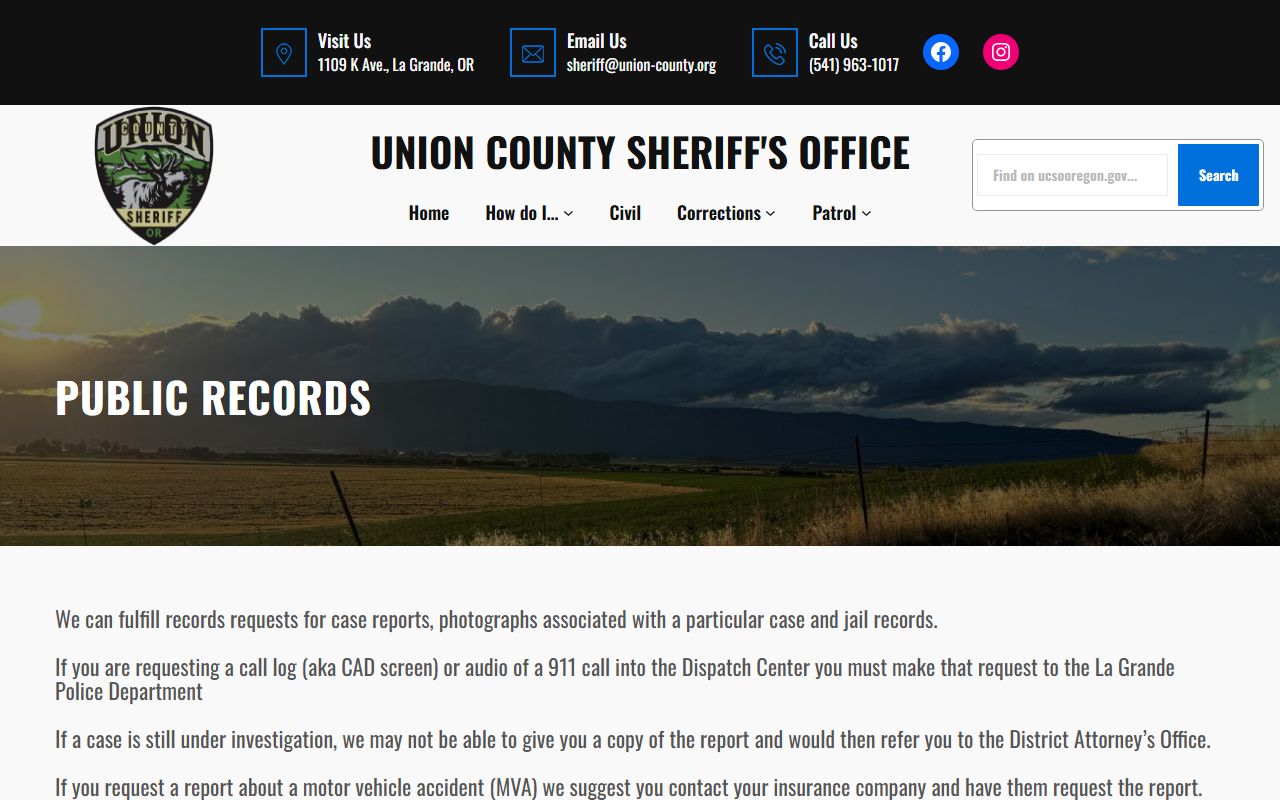
Sheriff records can support arrest context, while filed charges and outcomes must be checked in court records.
Statewide Charge and Criminal History Lookups
Statewide systems are fallbacks, not replacements for Union County source records. The Oregon DOC offender search applies to state-prison or post-county custody records. It may help after a person has left the county jail or after a sentence sends a person to state custody. It does not list every arrest, every booking, or every court charge filed in Union County.
The source from Oregon DOC Offender Search shows the state offender lookup route.
DOC records are most useful after sentencing or state custody, not at the first arrest-record stage.
Background Check Considerations
Arrest records and charge records are easy to misread in a screening context. An arrest is not a conviction. A charge is not proof of guilt. A roster can be a short-term custody list, and a court docket can lag behind real-time events or omit sealed material. Employment, tenant, credit, insurance, and similar regulated uses require proper legal screening procedures rather than casual public-record review.
Important: Do not use arrest or charge lookups as FCRA consumer reports for regulated decisions.
The source from the Oregon State Police Sex Offender Registry shows a separate public registry route.
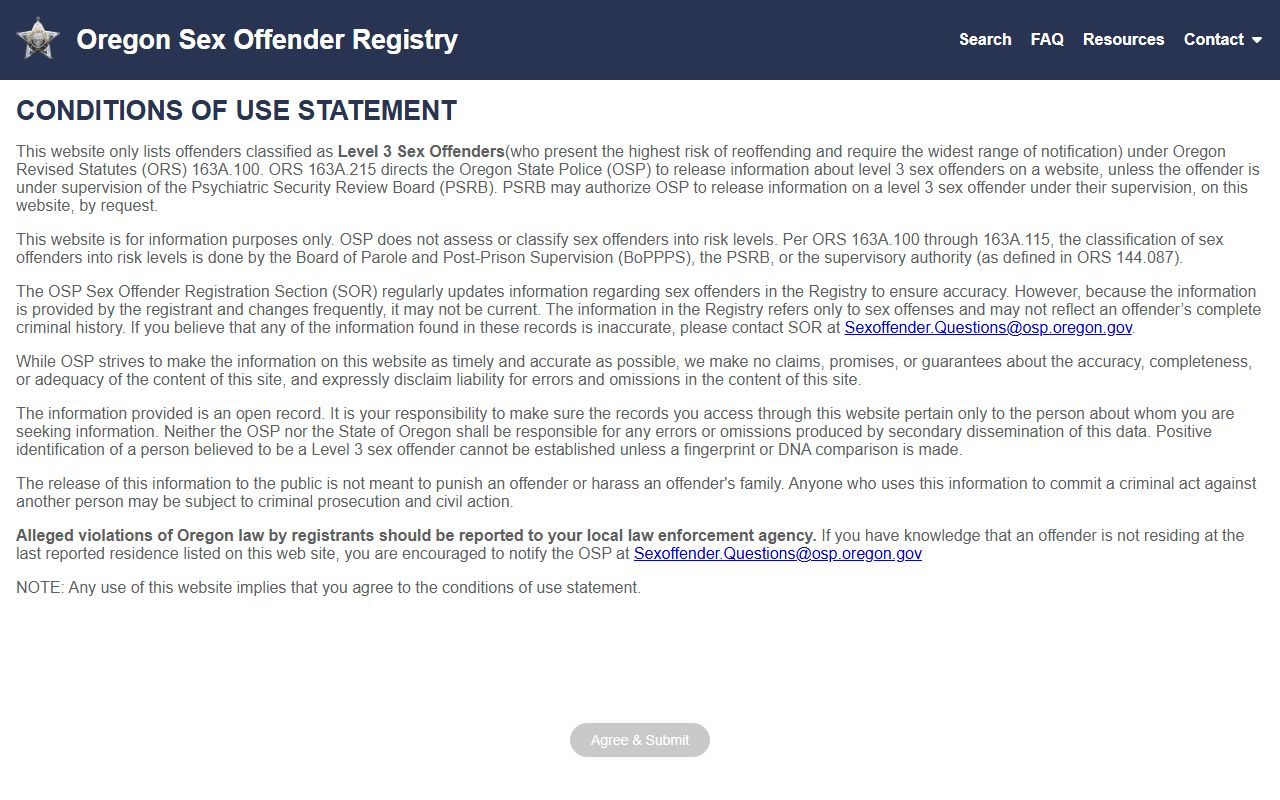
The registry is limited to legally publishable offender information and is not a full arrest or charge database.
Restricted Charge Records in Union County
Restricted arrest and charge records include juvenile matters, sealed or set-aside records, protected personal identifiers, adoption-related records, and law-enforcement reports withheld during investigation. UCSO says a case under investigation may not be released and may be referred to the District Attorney's Office. UCSO can fulfill case reports, photographs tied to a case, and jail records, but CAD or 911 audio must be requested from La Grande Police Department.
UCSO records requests may be emailed to UCSORecords@union-county.org, mailed or delivered to 1109 K Avenue, La Grande, OR 97850, or handled through the records request process. The Records Specialist line is 541-963-1017 ext. 222. UCSO cannot email records unless encrypted email is provided. Records may be faxed, picked up, or mailed for a fee.
Union County District Attorney
1104 K Avenue
La Grande, OR 97850
541-963-1007